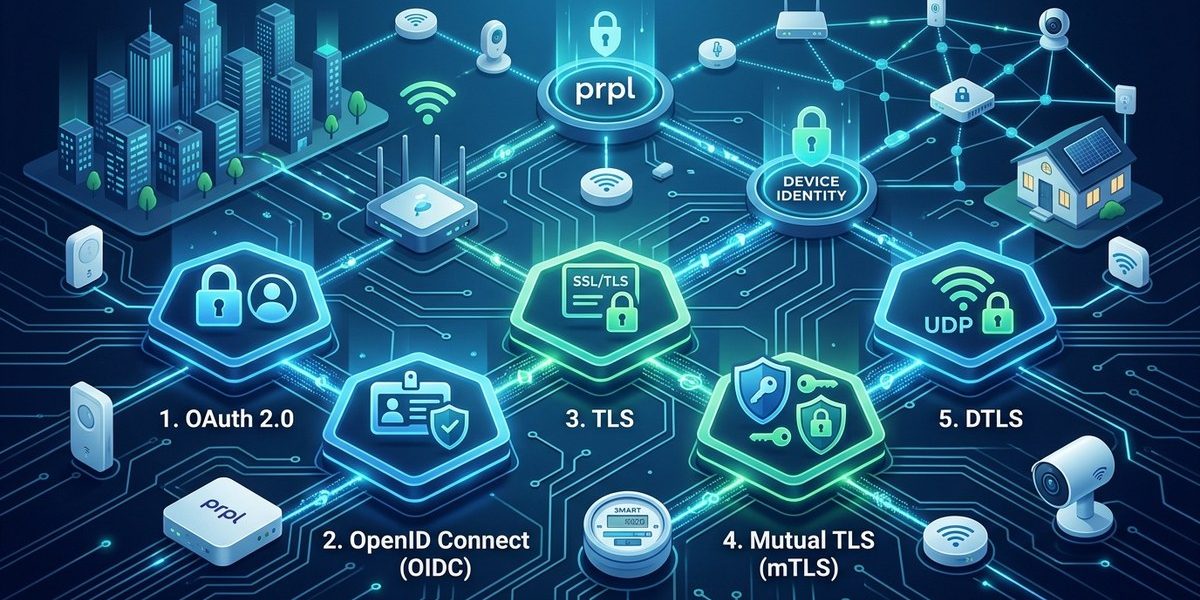

Every connected device has a story to tell. The question is whether that story belongs to the device or to someone who tricked it into trusting them. In 2026, with billions of IoT devices shipping each year, authentication is no longer just a checkbox on a compliance form. It is the difference between a smart building that keeps people safe and one that becomes a gateway for attackers. For engineers and developers building these systems, the choice of authentication protocol shapes everything from power consumption to patch cycles. Open source protocols have matured to the point where they offer production grade security without locking you into a vendor. Here is what you need to know about the five protocols that are defining IoT identity right now.
Open source IoT authentication protocols are the foundation of device identity security in 2026. This guide breaks down five proven protocols including DDS Security, OPC UA, mTLS, OSCORE, and ACE. Learn how each one handles authentication, where it fits best, and how to choose the right approach for your IoT deployment. No fluff, just practical insights for engineers building secure connected systems that scale across industries from smart homes to industrial automation environments and beyond.
Why Device Identity Matters More Than Ever
The shift from closed, single vendor IoT ecosystems to open, interoperable ones has been a massive win for innovation. But it also means that every device now needs to prove who it is before it can talk to anything else. Without strong authentication, an attacker can impersonate a sensor, inject false data, or pivot from a compromised light bulb to a critical controller.
Open source protocols have a unique advantage here. Their specifications are public, their implementations can be audited by anyone, and their communities catch vulnerabilities faster than most internal teams can. That transparency builds trust in a way that proprietary protocols cannot match. And when you combine that with the enhanced security available through open source embedded frameworks, you get a foundation that is both rigorous and adaptable.
The Five Open Source Authentication Protocols You Need to Know
These five protocols cover the spectrum from heavyweight industrial systems to battery powered sensors that transmit a few bytes a day. Each one solves authentication in a different way, and understanding their tradeoffs will help you pick the right tool for your use case.
1. DDS Security: Built for Real Time Critical Systems
Data Distribution Service (DDS) is not new, but its security extension, DDS Security, has become a go to for applications where milliseconds matter. Think autonomous vehicles, power grid controls, and surgical robotics. DDS Security uses a plugin architecture that supports authentication, access control, and encryption. Authentication happens through built in plugins that use X.509 certificates or shared secrets.
What makes DDS Security stand out is its trust model. It supports both peer to peer authentication and domain level permissions. That means a braking controller on a car can authenticate directly with a steering module without going through a central server. For real time systems, that direct trust is critical.
2. OPC UA: The Industrial Standard That Keeps Growing
OPC Unified Architecture (OPC UA) has been the backbone of industrial communication for years, and its security model keeps getting better. OPC UA authentication supports X.509 certificates, username/password, and token based methods. The protocol also includes a built in discovery service that validates device identities before they join a network.
For factory floors and SCADA systems, OPC UA's strength is its granularity. You can define exactly which operations each device is allowed to perform. A temperature sensor might be allowed to write to a specific data point but not read the controller's configuration. That kind of fine grained access control is rare in IoT protocols. If you are building for manufacturing or energy, OPC UA deserves a close look. And when paired with the right approach to building interoperable smart devices using open source technologies, it becomes even more powerful.
3. mTLS: The Generalist That Works Everywhere
Mutual TLS (mTLS) is the standard that most developers reach for when they need device to server authentication. It extends the TLS handshake so that both sides present certificates. The device authenticates the server, and the server authenticates the device. Simple, well understood, and supported by every major cloud platform.
mTLS works especially well for devices that have enough memory and processing power to handle certificate chains and asymmetric cryptography. Think smart home hubs, gateways, and edge servers. The main challenge is certificate management. Revoking a compromised certificate across millions of devices is not trivial, but open source tools like cert-manager and EJBCA make it manageable. For teams that want a developer focused guide to open source embedded security for smart devices, mTLS is often the first protocol to consider.
4. OSCORE: Purpose Built for Constrained Devices
Object Security for Constrained RESTful Environments (OSCORE) is a protocol designed for devices that cannot handle TLS. Think temperature sensors running on a coin cell battery, smart locks with limited RAM, or agricultural monitors in a field. OSCORE works at the application layer, which means it protects individual CoAP messages without requiring a full TLS handshake.
The beauty of OSCORE is that it uses pre shared keys and lightweight cryptography. A device can power up, send an authenticated reading, and go back to sleep in milliseconds. That efficiency is a game changer for battery powered deployments. OSCORE also supports group communication, so you can authenticate a whole cluster of sensors with a single key context. If you are working with constrained nodes, this protocol is probably your best bet.
5. ACE: Authorization for the Constrained World
Authentication and Authorization for Constrained Environments (ACE) is the IETF's answer to scaling trust in large IoT networks. ACE decouples authentication from authorization. A device authenticates once with an authorization server and receives an access token. It then presents that token to other devices or services to prove it has permission to act.
ACE uses CBOR Web Tokens (CWTs), which are much smaller than JSON Web Tokens. That makes it suitable for devices that have strict bandwidth limits. The protocol also supports multiple authentication mechanisms including raw public keys, pre shared keys, and certificates. For smart city deployments with thousands of streetlights or parking sensors, ACE gives you a centralized way to manage permissions without requiring every device to talk to a central server for every request.
How to Choose the Right Protocol for Your Project
The table below breaks down the key differences across the five protocols. Use it as a starting point, not a final answer.
| Protocol | Best For | Authentication Method | Resource Footprint | Certificate Management |
|---|---|---|---|---|
| DDS Security | Real time, critical systems | X.509, shared secrets | Moderate to high | Built in plugin support |
| OPC UA | Industrial automation | X.509, username, tokens | Moderate | Built in discovery and validation |
| mTLS | Cloud connected devices | X.509 certificates | Moderate to high | Requires external tooling |
| OSCORE | Constrained, battery powered | Pre shared keys | Very low | Key distribution must be managed |
| ACE | Large scale, constrained networks | Raw keys, pre shared, certs | Low | Centralized token issuance |
Each protocol has a sweet spot. The wrong choice can lead to excessive power draw, dropped connections, or security gaps that attackers will find. Take the time to match the protocol to your device's constraints and your deployment's scale.
A Practical Process for Evaluating Authentication Protocols
When you are comparing protocols for a new IoT product, follow this process to avoid costly mistakes.
-
List your device constraints. Measure available RAM, flash storage, CPU speed, and battery capacity. A protocol that works on a mains powered gateway may be impossible on a sensor node.
-
Define your trust model. Decide whether devices need to authenticate peer to peer, through a central server, or both. Write down which entities can issue credentials and how revocation works.
-
Evaluate the key management overhead. Estimate how many devices you will deploy, how often keys rotate, and who handles certificate issuance. A protocol with high overhead may not scale past a few hundred units.
-
Test with real hardware before committing. Run the protocol on your actual microcontroller or system on a chip. Simulation is fine for initial evaluation, but real hardware reveals timing issues and memory bottlenecks.
-
Plan for updates. Choose a protocol that allows credential rotation and algorithm agility. The cryptographic standards of 2026 may not be the same as 2030. You want a protocol that can evolve with you.
For a deeper look at how these protocols fit into a larger security posture, check out implementing robust security protocols for open source IoT devices.
Common Mistakes When Implementing IoT Authentication
Even with the right protocol, bad implementation can sink your security. Here are the mistakes I see most often, along with the fixes.
-
Hardcoding keys in firmware. This is the most common and most dangerous mistake. A single firmware dump gives an attacker permanent access to every device that uses that key. Use unique keys derived from a device secret or a secure element.
-
Ignoring revocation. Many teams deploy authentication without a way to remove compromised devices. Plan for revocation from day one. Your future self will thank you.
-
Using outdated cipher suites. TLS 1.2 with static Diffie Hellman is still out there in production. Move to TLS 1.3 or equivalent everywhere you can.
-
Skipping mutual authentication. Authenticating the server but not the device leaves the door open for device impersonation. Always authenticate both sides when possible.
| Mistake | Risk Level | How to Fix |
|---|---|---|
| Hardcoded keys | Critical | Use unique per device keys from a secure element |
| No revocation plan | High | Implement a certificate or token revocation list |
| Weak cipher suites | High | Enforce TLS 1.3 or equivalent modern ciphers |
| One way authentication | Medium | Enable mutual authentication everywhere |
Expert Advice on Protocol Selection
"The protocol you choose matters far less than the discipline with which you manage credentials. I have seen teams deploy state of the art protocols and still get breached because someone checked a private key into a public repository. Pick a protocol that fits your hardware, then spend twice as much energy on your key management lifecycle. That is where the real security lives." -- Senior IoT Security Architect, industrial automation firm (anonymous, used with permission)
That advice holds true across every protocol on this list. The mathematics behind authentication is solid. The weak points are always the human decisions around key storage, rotation, and revocation.
Building Your IoT Security Strategy Around Open Source
Authentication is not a one time decision. It is a practice that evolves as your fleet grows, as new attack surfaces emerge, and as cryptographic standards shift. Open source protocols give you the flexibility to adapt without being held back by vendor roadmaps. You can inspect the code, contribute fixes, and build on the work of thousands of other engineers.
Start with the protocol that matches your device constraints and trust model. Test it on real hardware. Plan your key management before you ship a single unit. And stay engaged with the communities behind these protocols. That engagement is what keeps open source ahead of proprietary alternatives.
For teams that want to go further, take a look at building secure smart devices with open source IoT frameworks. The frameworks and protocols work together to create a security posture that is greater than the sum of its parts.
The devices you build today will be in the field for years. Give them an identity that cannot be stolen, copied, or forged. Open source authentication protocols give you the tools to do exactly that. Use them wisely, and your devices will always know who they are talking to.