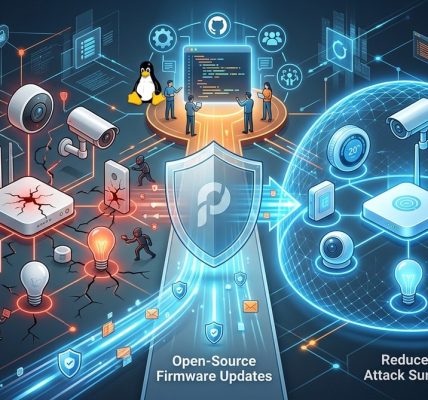
The pressure is on for embedded engineers in 2026. New regulations from the EU Cyber Resilience Act and similar frameworks in the US are forcing every IoT device maker to prove their boot chain is tamper-proof. Proprietary secure boot solutions have worked for years, but they are expensive, opaque, and hard to audit. That is why a growing number of firmware engineers are turning to open-source secure boot tooling. Projects like UEFI, Trench Boot, and Heads offer transparency and community validation, but they also come with their own integration challenges. This guide covers what every developer must know about open-source secure boot for IoT in 2026, from regulatory drivers to practical implementation steps.
Open-source secure boot for IoT in 2026 is no longer optional for compliance. Projects like Trench Boot and Heads let you audit every byte of your boot chain, but they require careful hardware integration. Start by mapping your boot stages, then pick a project that supports your SoC. Use measured boot with remote attestation to satisfy regulators without locking yourself into a single vendor.
Why Open-Source Secure Boot Matters More Than Ever in 2026
The regulatory landscape shifted hard in the last 18 months. The US Cyber Trust Mark program now requires connected devices to ship with a verified boot chain. The EU Cyber Resilience Act demands that manufacturers provide software bill of materials (SBOMs) and proof of secure updates. Proprietary secure boot implementations make it difficult to produce those proofs because the signing keys and verification logic are hidden inside a vendor black box.
Open-source secure boot flips that model. You can see the exact code that verifies your boot stages. You can compile it yourself, sign it with your own keys, and submit the whole chain for a third-party audit. For a mid-to-senior level firmware engineer, that transparency is a massive advantage when your legal team asks for evidence during a compliance review.
The Three Major Open-Source Secure Boot Projects You Need to Know
Not all open-source secure boot projects are created equal. Each targets a different hardware profile and threat model. Here are the three you will encounter most often in 2026.
UEFI Secure Boot (with Open-Source Shim)
The standard UEFI secure boot implementation is widely supported on x86 and some ARM platforms. The open-source shim project acts as a small first-stage bootloader that validates the next stage against a certificate stored in firmware. It works well for devices that already run UEFI firmware, but many IoT devices use lightweight MCUs or custom boot sequences that do not support UEFI at all.
Trench Boot
Trench Boot is a Linux-based secure boot framework designed specifically for embedded devices. It uses a minimal Linux initramfs to measure every stage of the boot process and store those measurements in a Trusted Platform Module (TPM). It is a good fit for devices running Embedded Linux on ARM or RISC-V SoCs. Trench Boot does not require UEFI, which makes it popular for custom IoT gateways and industrial controllers.
Heads
Heads is a firmware distribution that replaces the stock BIOS or UEFI on x86 laptops and embedded PCs. It uses a patched coreboot and a TPM to implement measured boot with a physical attestation key. Heads is ideal for devices where an operator needs to verify the integrity of the boot chain before entering a passphrase, such as a secure IoT management console.
How to Choose the Right Open-Source Secure Boot Tool for Your IoT Device
Making the wrong choice here can delay your shipping timeline by months. Use the table below to match your hardware and threat model to the right project.
| Project | Best For | Hardware Support | Key Strength | Compliance Fit |
|---|---|---|---|---|
| UEFI + Shim | x86 and some ARM devices that already run UEFI | x86, ARM (limited) | Broad hardware support, easy integration | Cyber Trust Mark, EU CRA |
| Trench Boot | Embedded Linux devices without UEFI | ARM, RISC-V, x86 | Measured boot with TPM, no UEFI required | EU CRA, NIST SP 800-193 |
| Heads | x86 embedded PCs needing operator verification | x86 (coreboot) | Physical attestation key, tamper-evident boot | High-security deployments |
A Practical Process for Evaluating Open-Source Secure Boot
Follow this numbered process to evaluate and adopt open-source secure boot for your next IoT project.
- Map your boot stages. Document every step from power-on to kernel execution. Identify which stages are mutable and which can be measured.
- Check your SoC compatibility. Does your chip have a TPM or a hardware root of trust? If not, you may need to add a secure element.
- Select a project from the table above. Prototype with the one that matches your hardware profile. Run the build toolchain on your target platform.
- Generate your own signing keys. Never use the default test keys shipped with any open-source project. Generate production keys and store them in a hardware security module (HSM).
- Implement measured boot with remote attestation. Configure the boot loader to store measurements in TPM PCRs. Send those measurements to a remote verifier during device enrollment.
- Test the recovery path. What happens if a boot stage fails verification? Your device must have a failsafe update mechanism that does not bypass the secure boot chain.
Common Mistakes When Implementing Open-Source Secure Boot
Even experienced firmware engineers make these errors. Avoid them to save weeks of debugging.
- Using default test keys in production. This is the number one mistake. Attackers can sign malicious boot loaders with publicly known test keys.
- Ignoring the update path. A secure boot chain that cannot be updated securely is a liability. You must sign firmware updates with the same key hierarchy used for boot verification.
- Skipping the hardware root of trust. Software-only secure boot is better than nothing, but it cannot protect against physical attacks. A TPM or secure element is required for regulatory compliance in most 2026 frameworks.
- Overlooking supply chain attacks. Your signing keys are only as safe as the build server that generates them. Use an isolated, air-gapped signing environment.
What Regulatory Compliance Looks Like in 2026
Regulators are not asking for a specific implementation. They are asking for proof. You need to show that your device boots only authenticated firmware, that the boot measurements are recorded, and that those measurements can be verified by a third party.
Open-source secure boot makes this easier because you can share the source code, the build configuration, and the signing policy with an auditor. A proprietary solution would require a non-disclosure agreement just to let the auditor look at the boot loader code.
“The biggest shift we see in 2026 is that regulators are requiring SBOMs and boot chain evidence for all consumer IoT devices. Open-source tooling is the most cost-effective way to produce that evidence without licensing fees.” — Sarah Chen, firmware security consultant and former NIST contractor.
Integrating Open-Source Secure Boot with Your Existing CI/CD Pipeline
Your firmware build pipeline must be updated to include key generation and signing steps. Here are the essential changes.
- Add a signing stage. After the firmware image is built, it must be signed with the production key before it is packaged for OTA distribution.
- Store keys in a hardware security module. Never store production keys on a build server disk. Use a network-attached HSM or a dedicated signing appliance.
- Verify the signature in your test harness. Your automated tests should simulate the boot process and confirm that the signed image passes secure boot verification.
- Generate a software bill of materials. Every signed release should include an SBOM that lists all open-source components and their versions.
A Look at the Tooling Landscape for 2026
The open-source secure boot ecosystem is maturing fast. Here are a few tools and libraries that complement the main projects.
- fwupd is an open-source firmware update daemon that supports signed updates for Linux-based IoT devices.
- swtpm is a software TPM simulator that lets you test measured boot without physical hardware.
- cryptography libraries like OpenSSL and GnuTLS provide the signing and verification primitives.
- sbom-tool and tern help generate and validate software bills of materials.
For a deeper look at how these tools fit together, read our guide on enhancing IoT security with open-source embedded frameworks. It covers the full stack from boot loader to application layer.
Your Next Steps for Adopting Open-Source Secure Boot
Do not wait until your next compliance audit to start this work. Begin with a pilot project on a single device model. Use that experience to build a repeatable process for your entire product line.
- Choose a device with a supported SoC and a TPM.
- Set up a test signing infrastructure with an HSM.
- Implement measured boot using Trench Boot or Heads.
- Write automated tests that verify the boot chain.
- Document your key management policy for auditors.
The investment is worth it. Open-source secure boot gives you full control over your device security, eliminates vendor lock-in, and provides the transparency that regulators now demand.
Building a Trusted Boot Chain That Lasts
The most important lesson from 2026 is that secure boot is not a one-time configuration. It is a process that must be maintained across every firmware update, every product revision, and every new regulation. Open-source tooling makes that maintenance manageable because you can fork the project, patch it for your specific hardware, and share your improvements with the community.
Start small. Pick one device, implement the chain, and document everything. Once you have that foundation, scaling to your entire fleet becomes a matter of process, not panic. Your users and your legal team will thank you.