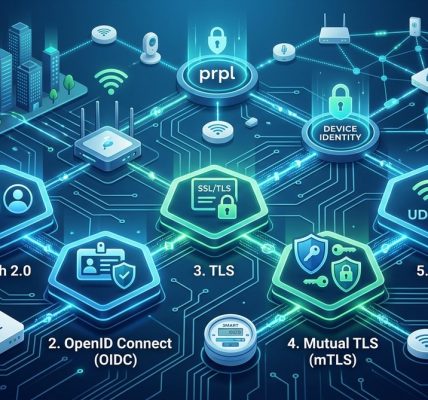

Firmware is where the real battle for IoT security happens. Every connected device, from a smart thermostat to an industrial sensor, depends on firmware that can withstand constant probing. In 2026, the pressure is higher than ever. New regulations demand stronger protections, and attackers have become more sophisticated. Relying on proprietary, closed source security modules no longer cuts it. The best defense starts with open source security libraries for IoT firmware, because they offer transparency, community vetting, and continuous improvement. Let’s walk through why they are now essential and how to choose the right ones for your next build.
Open source security libraries give IoT firmware developers proven, auditable code that reduces attack surfaces and speeds up compliance. In 2026, with mandates like the EU Cyber Resilience Act and US IoT security laws, using these libraries is no longer optional. By selecting active, well-maintained projects and integrating them carefully, you can protect devices throughout their lifecycle.
The Growing Threat Landscape for IoT Firmware in 2026
The number of connected devices worldwide has topped 30 billion, and each one is a potential entry point. Attackers no longer just go after web servers; they target the firmware itself. Insecure bootloaders, weak cryptographic implementations, and unpatched vulnerabilities have led to major botnets and data breaches.
Regulators have taken notice. The EU Cyber Resilience Act, now in full effect in 2026, imposes strict security requirements on any internet connected product sold in Europe. The United States has followed with its own IoT security labeling and mandatory update policies. These laws force developers to prove that their firmware uses trusted cryptographic primitives, secure update mechanisms, and robust authentication.
Proprietary security libraries are risky. You cannot fully audit them. You depend on a single vendor for patches. Open source libraries, on the other hand, let you inspect every line of code. They are maintained by communities that respond to vulnerabilities quickly. That transparency is exactly what regulators want to see.
If you are building for today’s market, you need to get serious about meeting IoT security regulations in 2026. Open source libraries give you a strong foundation.
What Makes a Great Open Source Security Library?
Not every open source crypto package is suitable for embedded firmware. You need a library that fits the constraints of a microcontroller while still providing modern protections. Here are the qualities to look for:
- Small memory footprint. Most IoT devices have RAM measured in kilobytes. A library that needs megabytes is out.
- Support for hardware acceleration. Many chips include cryptographic coprocessors. The library should leverage them for speed and energy savings.
- Regular releases and active maintenance. A project with no commits in six months is a risk.
- Strong community governance. Look for a foundation or steering committee that oversees security patches.
- Clear documentation and examples. Firmware developers are often time constrained. Good docs reduce mistakes.
- Compliance with standards like FIPS 140-3, NIST SP 800-56, or the upcoming NIST post-quantum algorithms.
Choosing the right library early in the design phase saves you from painful rewrites later. When you select one that meets these criteria, you are setting your device up for a longer, safer life.
Top Open Source Security Libraries for IoT Firmware
Several libraries have earned strong reputations in the embedded security space. Let us look at a few that are widely used in 2026 and compare them side by side.
| Library | License | Minimum RAM | Hardware Acceleration | TLS 1.3 | Post Quantum Ready |
|---|---|---|---|---|---|
| mbed TLS | Apache 2.0 | 32 KB | Yes (HW crypto) | Yes | In progress |
| WolfSSL | GPL / Commercial | 10 KB | Yes | Yes | Yes (experimental) |
| OpenSSL | Apache 2.0 | 256 KB | Partial | Yes | No |
| BearSSL | MIT | 20 KB | Limited | Yes | No |
mbed TLS is a solid choice for ARM based microcontrollers. It is used in many commercial IoT products and has excellent community support. WolfSSL offers the smallest footprint and has added experimental post-quantum algorithms, which may become important by the end of the decade. OpenSSL is powerful but too heavy for most constrained devices. BearSSL is a lighter alternative that focuses on simplicity and security.
For many projects, WolfSSL or mbed TLS will be the right call. But always test the library on your exact hardware before committing.
You can also combine these libraries with other open source components to build a more comprehensive system. For example, consider enhancing IoT security with open-source embedded frameworks that include secure boot and key management.
How to Choose the Right Library for Your Project
Selecting a security library is not a one size fits all decision. Use this step by step process to find the best fit.
- Assess your hardware constraints. Check available Flash, RAM, and any built-in crypto accelerators. This will narrow down the list immediately.
- Define which protocols you need. Do you require TLS 1.3, DTLS, MQTT over TLS, or just signature verification for firmware updates? Write down each requirement.
- Evaluate community health. Visit the project’s repository. Look at recent commits, issue response times, and release cadence. A healthy community means faster fixes.
- Check compliance status. If your product must meet regulations like the EU Cyber Resilience Act, verify that the library has been audited or follows recognized standards.
- Run a performance test. Build a minimal test firmware with the library and measure boot time, memory usage, and power consumption. Real numbers beat theoretical specs.
- Plan for updates. Choose a library that provides a clear migration path between versions. Firmware updates should not break existing devices.
“Do not treat the security library as a black box. Treat it as a critical component that you own. Verify its provenance, keep it updated, and test it in your own environment.” — Embedded security engineer at a leading smart home company, 2026.
Common Pitfalls When Integrating Security Libraries
Even a good library can cause problems if integrated poorly. Watch out for these mistakes.
- Using an old fork that is no longer maintained. Many developers copy a library into their repository and never update it. This is a ticking bomb.
- Ignoring memory limits. A TLS handshake can use 20 KB of RAM. If your device only has 32 KB total, you might run out of memory for other tasks.
- Storing private keys in flash without encryption. Some libraries provide functions to store keys securely, but you must enable them.
- Skipping entropy source verification. Weak random number generation breaks almost all cryptography. Make sure your hardware random generator is working.
- Disabling certificate validation during testing and forgetting to re enable it. This happens more often than you think.
A good practice is to integrate the library early in development and run a static analysis on the whole firmware. Catching mistakes before production is vastly cheaper.
Real World Examples of Secure Firmware with Open Source Libraries
Consider a smart home hub that uses mbed TLS for its TLS connections to the cloud and for signing firmware updates. The developers chose mbed TLS because it supports the MCU’s hardware crypto engine, reducing handshake time from 500 ms to 50 ms. They also used the library’s built in X.509 certificate validation to ensure each update comes from the manufacturer.
Another example: an industrial sensor communicating over LoRaWAN uses WolfSSL to implement DTLS. The sensor runs on a Cortex M0+ with only 16 KB of RAM, and WolfSSL fits with room to spare. The project also benefits from WolfSSL’s constant time implementations to resist side channel attacks.
These are not hypothetical scenarios. Teams across the world are already deploying open source security libraries in production. The key is to treat security as a core feature, not an afterthought.
You might also be interested in building interoperable smart devices using open-source technologies to ensure your devices can communicate securely across different platforms.
Building a Secure Firmware Update Pipeline
One of the most critical uses of a security library is to enable signed and encrypted firmware updates. Without them, attackers can push malicious updates to your devices. An open source library like mbed TLS or WolfSSL can verify signatures and decrypt the new firmware safely.
A typical pipeline looks like this:
- The manufacturer signs the firmware image with a private key.
- The device, using the public key stored in its secure element, verifies the signature before applying the update.
- The library also handles the TLS connection to the update server, protecting the image in transit.
This approach is a core part of the how open-source firmware updates reduce IoT attack surfaces strategy. Without a trusted library, you would have to implement all of this from scratch, which is error prone and hard to audit.
The Path Forward: Open Source as a Security Standard
In 2026, the IoT industry is moving toward open standards for security. Proprietary libraries create lock in and make it harder for security researchers to review the code. Open source libraries level the playing field. They let smaller companies compete with giants because they have access to the same high quality cryptography.
Expect to see more consortiums and foundations backing open source security projects. The prpl Foundation, for example, supports open source firmware and security initiatives that help embedded developers. Their work is part of a larger trend: the recognition that security is a shared responsibility.
If you want to understand the bigger picture, read about how open source is the foundation for trusted IoT ecosystems. It explains why collaboration and transparency beat secrecy when protecting devices at scale.
Your Next Steps for Securing IoT Firmware
Do not wait for an incident to force you into action. Start evaluating open source security libraries for your current or next IoT project. Pick one library, test it on a prototype board, and build a small proof of concept that performs a secure firmware update or handles a TLS connection.
Document your choices and the reasoning behind them. That documentation will be invaluable during regulatory audits and when you onboard new team members.
The devices you build today will be in the field for years. Give them the best protection available by using open source security libraries that are transparent, auditable, and actively maintained. Your users and your reputation will thank you.