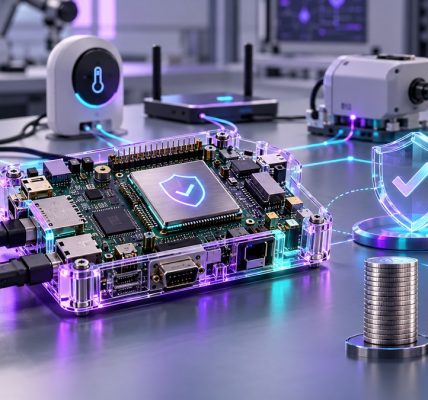
Why Open-Source TPMs Are the Missing Link for Hardware-Grade IoT Security in 2026

The Trusted Platform Module has been the gold standard for hardware security for years. But for IoT device makers, the proprietary TPM ecosystem has always felt like a locked door. You pay a premium for a black box, you sign NDAs that make audits awkward, and you pray the supply chain never hiccups. In 2026, that model is cracking under pressure from new regulations, supply chain attacks, and a demand for transparency that proprietary vendors simply cannot satisfy. The answer is not a new chip. The answer is open-source TPMs.
Open-source TPMs deliver the same hardware-grade root of trust as proprietary modules but with full code transparency, lower per-unit costs, and faster compliance paths for regulations like the EU Cyber Resilience Act. For IoT architects in 2026, they are no longer a niche alternative. They are becoming the default choice for secure, auditable, and interoperable device fleets.
Why Proprietary TPMs Are Letting You Down
Proprietary TPMs were designed for PCs, not for the wild diversity of IoT. They work fine inside a corporate laptop. But when you need to embed one into a smart thermostat, a medical patch, or an agricultural sensor, the friction becomes obvious.
First, the cost. A dedicated TPM chip adds a few dollars to the BOM. That might not sound like much, but at scale, it eats margins. Second, the audit problem. You cannot inspect the code running inside a proprietary TPM. You have to trust the vendor’s word that there are no backdoors or subtle implementation flaws. Third, the supply chain risk. If your TPM vendor has a shortage or a geopolitical issue, your entire product line stalls.
These problems are not new. But in 2026, they are becoming dealbreakers. Regulators are asking for proof of security, not just promises. Customers are demanding supply chain transparency. Open-source TPMs solve all three issues at once.
What Exactly Is an Open-Source TPM?
An open-source TPM is a Trusted Platform Module whose firmware, cryptographic libraries, and interface logic are publicly available for review, modification, and audit. It can run on dedicated secure hardware, or it can be implemented as a firmware TPM (fTPM) inside a trusted execution environment like a secure enclave or a RISC-V security core.
The key difference from a proprietary TPM is the code. You can read it. You can compile it. You can verify that it does exactly what it claims, and nothing else.
Several open-source TPM implementations have matured significantly in the last two years. Projects like the Open TPM by Microsoft and the TPM 2.0 reference implementation from the Trusted Computing Group now have active maintainers, security patches, and community support. For embedded Linux and Zephyr RTOS targets, you can integrate a software TPM that provides the same cryptographic primitives and attestation flows as a hardware module.
How Open-Source TPMs Fix the Compliance Headache
The EU Cyber Resilience Act (CRA) and similar frameworks in the US and Asia are rewriting the rules for IoT security. They require manufacturers to provide evidence of secure boot, secure updates, and device identity. A TPM is the natural foundation for all of these, but only if you can prove its integrity.
With a proprietary TPM, proving integrity means paying a third party to audit a binary blob you cannot see. With an open-source TPM, you can run your own audits. You can integrate the build into your CI/CD pipeline and verify that the firmware matches the source. You can generate a Software Bill of Materials (SBOM) that lists every line of code in the TPM firmware.
This transparency is not just a nice to have. It is becoming a regulatory requirement. If a regulator asks, “How do you know your TPM is secure?”, the open-source answer is simple: “Here is the source code. Here is our audit trail. Here is the SBOM.” The proprietary answer is a lot more complicated.
Three Steps to Adopt an Open-Source TPM for Your Next IoT Device
If you are ready to move from proprietary to open-source TPMs, here is a practical path that works for most embedded projects in 2026.
-
Choose your TPM implementation and hardware target. For a dedicated hardware TPM, look at open-source firmware compatible with common secure elements or RISC-V cores. For a firmware TPM, select the Open TPM library and port it to your embedded OS. The Zephyr RTOS and Embedded Linux both have mature integration guides.
-
Integrate the TPM into your secure boot and attestation flow. The TPM should measure the boot sequence, store the measurements in its Platform Configuration Registers (PCRs), and provide remote attestation to a verification server. This is the same flow used by proprietary TPMs, but now you control the code.
-
Set up a continuous audit pipeline. Use the open-source SBOM tools to generate a bill of materials for your TPM firmware. Run vulnerability scanners against the source. Subscribe to security mailing lists for the project. When a CVE is published, you can patch your fork immediately instead of waiting for a vendor.
This process gives you hardware-grade security with software-grade agility. You are no longer dependent on a vendor’s patch schedule.
Common Mistakes When Switching to Open-Source TPMs
Even experienced teams make missteps. Here is a table of the most common errors and how to avoid them.
| Mistake | Why It Hurts | How to Fix It |
|---|---|---|
| Using a software TPM on a device without a secure enclave | The TPM secrets can be extracted from memory | Pair the fTPM with a hardware secure element or a TEE like Intel SGX or Arm TrustZone |
| Not verifying the build chain of the TPM firmware | A compromised build tool can inject a backdoor | Reproduce the build in a clean environment and compare the hash with the official release |
| Skipping SBOM generation for the TPM code | You lose visibility into dependencies | Add SBOM generation to your CI pipeline using tools like CycloneDX |
| Assuming the TPM handles all security | The TPM is just one layer. It does not secure the network or the application | Use the TPM for root of trust, then layer on network security and application hardening |
What the Experts Say
“The biggest advantage of open-source TPMs is not the cost savings. It is the ability to do a real security review. With proprietary TPMs, you are trusting a vendor’s marketing team. With open-source, you are trusting the code. That is a fundamental shift in how we build trust into devices.”
— Lead Security Architect at a major industrial IoT firm, speaking at Embedded World 2026
This shift is already happening in sectors that cannot afford to trust blindly: medical devices, critical infrastructure, and automotive. These industries are adopting open-source TPMs not because they are cheaper, but because they are auditable.
How Open-Source TPMs Enable True Interoperability
One of the hidden costs of proprietary TPMs is vendor lock-in. Each vendor has its own provisioning toolchain, its own API quirks, and its own certification process. Switching vendors means re-qualifying the entire security stack.
Open-source TPMs break that lock-in. Because the interface is standardized (TPM 2.0), and the implementation is open, you can move between hardware platforms without rewriting your security logic. You can use a software TPM during prototyping, then switch to a hardware TPM for production, all with the same codebase.
This flexibility is a game changer for teams that build multi-vendor IoT ecosystems. It allows you to choose the best hardware for each device class without being held hostage by a single TPM vendor. For more on building interoperable systems, read our guide on building interoperable smart devices using open-source technologies.
The Role of Open-Source TPMs in Zero-Trust IoT Architectures
Zero Trust is not just a buzzword for corporate networks. It applies to IoT too. The core idea is simple: never trust, always verify. Every device must prove its identity and integrity before it is allowed to communicate.
An open-source TPM is the perfect foundation for a Zero Trust IoT device. It provides a hardware-anchored identity that cannot be cloned. It attests to the device’s boot state. It signs every message with a private key that never leaves the TPM.
Because the TPM code is open, you can verify that the attestation protocol is implemented correctly. You can also extend it to support new cryptographic algorithms as standards evolve. For a step-by-step guide on building a device from the ground up, check out our article on how to build a zero-trust IoT device with open-source embedded components.
What the Future Holds for Open-Source TPMs in 2026 and Beyond
The momentum behind open-source TPMs is accelerating. Several trends are converging to make them the standard choice for IoT security.
First, the RISC-V ecosystem is maturing. RISC-V cores with dedicated security features are becoming available at price points that compete with traditional microcontrollers. Open-source TPM firmware can be compiled directly for RISC-V, creating a fully open hardware and software stack. Learn more in our piece on why open-source RISC-V is reshaping secure IoT development in 2026.
Second, the tooling around open-source TPMs is improving. Build systems, test suites, and SBOM generators are all becoming easier to use. The barrier to entry is lower than it has ever been.
Third, regulators are starting to mandate transparency. The EU Cyber Resilience Act explicitly encourages the use of open standards and verifiable security mechanisms. Open-source TPMs are a natural fit for this regulatory environment.
The Path Forward for IoT Security Architects
You do not need to rip out every proprietary TPM tomorrow. But you should start evaluating open-source alternatives for your next product generation. Run a pilot. Port the Open TPM library to your embedded Linux build. Set up an attestation server. See how it feels to have full control over your root of trust.
The shift to open-source TPMs is not a radical departure. It is a return to the principles that made the internet work: transparency, auditability, and community-driven security. In 2026, those principles are not optional. They are the only way to build IoT devices that can be trusted at scale.
Start small, but start now. The next time you spec out a new IoT product, ask yourself: would I rather trust a vendor’s NDA, or trust code I can read? The answer will guide you toward a more secure, more open future for your devices.